
AI is increasingly embedded in security engineering. It correlates signals, detects anomalies, and supports automated decision-making. The practical question for engineers is no longer whether AI improves analysis, but where its effectiveness stops.
Security failures rarely originate in decision logic.
They originate where decisions meet execution.
Decisions Do Not Secure Systems. Execution Does.
AI operates at the decision layer. It reasons over signals, probabilities, and inferred intent. Security outcomes, however, are determined at execution points:- When a device attaches to the network,
- When a session is established or persists,
- Before a process executes and its runtime behavior unfolds.
Accountability Follows Execution Paths
As automation and autonomy increase, more actions are triggered without human intervention. Responsibility does not move with automation. Incident response, audit, and root-cause analysis consistently trace back to execution layers: network attachment, session control, and runtime behavior. When something breaks, engineers investigate what was allowed to execute, under what state, and why it was not stopped, not which model produced the recommendation. Autonomous decisions are acceptable only when execution is:- Observable,
- Constrained,
- Reversible.
Failures Escalate When Gates Remain Open
Breach analysis repeatedly shows the same pattern. Incidents escalate after access is granted and not re-evaluated. Credentials are reused. Sessions persist. Runtime behavior drifts without intervention.- This is not a detection problem.
- It is a gatekeeping problem.
Gatekeepers Define Where Security Is Real
A gatekeeper is not a product category. It is a system role. Gatekeepers exist at choke points where actions must pass:- Network attachment points,
- Session establishment and continuation,
- Runtime execution on endpoints.
- Visibility into the current state of the actor attempting to act
- Control over whether and how that action proceeds
Gatekeeper Visibility Is State-Based, Not Event-Based
Gatekeeper visibility is not about collecting more logs. It is about observing actor state at the moment of execution. At the gate, visibility answers concrete questions:- Who or what is acting?
- From where, with what posture and context?
- Does this state still justify the trust previously granted?
Security Operates on Actors
Security does not fail because an event occurred. It fails because an actor was allowed to act. Actors include:- Users,
- Devices,
- Workloads,
- Service accounts,
- Autonomous processes, including AI agents.
The Front Line Matters
Effective gatekeepers sit as close as possible to execution. In enterprise environments, this often means the front line at Layer 2. At this level:- Actors cannot attach without being observed,
- Identity and posture are directly visible, Enforcement occurs before lateral movement begins.
- Sensors
- collect state at network and infrastructure choke points,
- provide consistent, actor-centric visibility,
- anchor trust decisions to real attachment and context.
- Agents
- enforce decisions at runtime,
- observe processes, memory activity, and system behavior as execution unfolds,
- provide containment and reversibility when actor state deviates.
Where AI Fits
AI is effective when it reasons over gatekeeper-quality data. When AI consumes state observed at execution points and feeds decisions back into those same points, automation becomes predictable. When AI operates on abstracted or delayed signals, automation becomes speculative. AI does not replace gatekeepers. It amplifies them.The Genians Approach
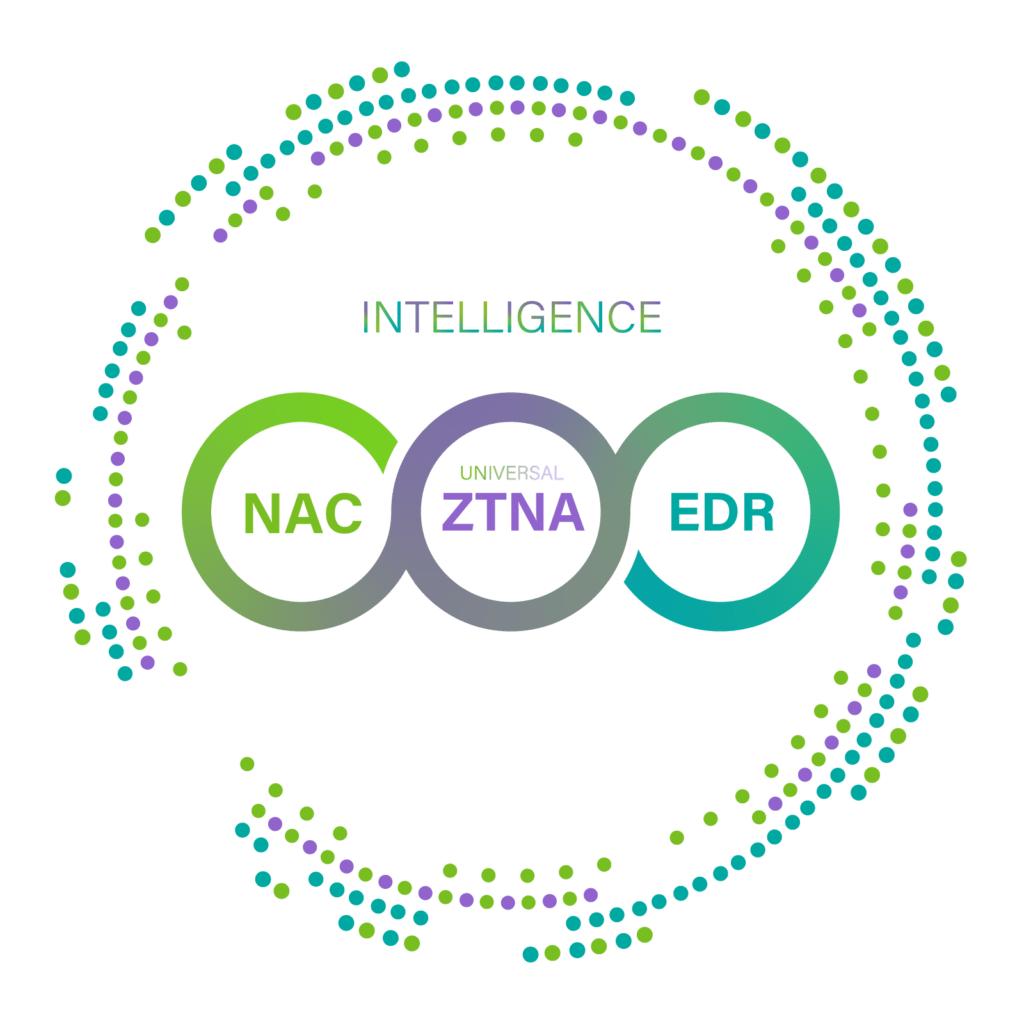
Genians treats Network Access Control (NAC), Zero Trust Network Access (ZTNA), and Endpoint Detection & Response (EDR) as a continuous gatekeeper across execution stages, not as isolated tools.- NAC governs actor state at network attachment, where visibility and control first converge.
- ZTNA governs actor state during active sessions, continuously re-evaluating trust.
- EDR governs actor state before and during runtime execution, where behavior, memory activity, and system interaction determine impact.
Conclusion
AI improves how decisions are made. Security outcomes are determined by where those decisions are enforced. In cybersecurity, the gate is where reality is decided.- Visibility at the gate shows what is happening.
- Control at the gate determines what happens next.